

Privacy Policy | Terms & Conditions | Refund Policy
Copyright PivotHolisticHealth.com © 2016. All rights reserved.
Web Development by Socialfuel, LLC | Chief Editor: Christina DeFrancesco
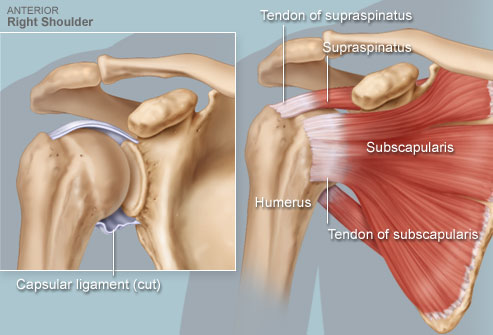
If you have a shoulder injury, there is a good chance it involves the rotator cuff. I can not tell you how many times I’ve seen an injury that likely could have been avoided with regular rotator cuff strengthening.
So what is a rotator cuff?
The short answer is 4 relatively small muscles that are integral to holding your upper arm bone in the right location during shoulder movement. Yes, there are other muscle that do that, bigger muscles too but the rotator cuff is probably the most important set. Picture the top part of the upper arm bone. The top part of the bone, the part that connects to the shoulder looks like a shaft and a ball at the top. The ball on top is called the head of the humerous. Above that is a “roof” of bone. If you feel the very top of you shoulder, when you follow your collar bone out, you can feel the top of the shoulder is really hard, that is called your acromion bone.
So in review I’ve mentioned three major players so far: the head of the humerous, the acromion, and the rotator cuff. They are all have to work together for movement in the shoulder. This is quite an important job that is complicated by a large grouping of nerves and arteries that happen to run in that space between the head of the humerous and the acromion. The rotator cuffs job is to hold that head of the humerous from coming into contact with the acromion and also preventing impingement (squeezing) the nerves and arteries that run in that space as well.
The rotator cuff looks like 4 little muscles wrapped around a ball, the same way a pitchers fingers wrap a round a baseball. It holds it tight into that shoulder joint, not allowing the ball portion of the bone to have a lot of excess movement with in the shoulder.
So, what happens if the rotator cuff is not strong?
The bones are going to be grinding around in the shoulder. You have tendons in there, joint capsules, muscles, arteries, and nerves. The constant grinding could possibly eventually cause arthritis or damage to any of the other structures I mentioned.
In short, a strong rotator cuff keeps the bones in the shoulder in a stable position so that the optimum joint space is kept and we don’t have bones grinding on bones or bones grinding on soft tissue shoulder structures.
When we have problems with our rotator cuff we experience: weakness, numbness and tingling, blood flow problems, and lose the ability to move our shoulder in certain motions.
Contact me at 407-205-7488 for a complimentary rotator cuff exam and also a preventative rotator cuff strengthening sample protocol.